文章目录
交易系统:使用 C++ 内存池避免动态内存分配 交易系统:使用 C++ 内存池避免动态内存分配 交易系统:使用 C++ 内存池避免动态内存分配
这是学习 《Building Low Latency Applications With C++: Develop a Complete Low Latency Trading Ecosystem From Scratch Using Modern C++》 的读书笔记。BTW,这本书真是一本好书,是市面上为数不多讲解交易系统架构的书籍,逐层讲解,深入浅出👍
要解决的问题
在一般的做法当中,一个非 static 的对象的生命周期与其内存生命周期是一致的,但是这样就要求动态分配内存,在 runtime 时在 heap 上给这个对象分配内存空间。但是动态内存分配的 overhead 很大。所以在 low latency applications 当中我们希望不要有动态内存分配,于是我们把 “对象生命周期” 与 “内存生命周期” 进行解耦:在启动时就申请足够的内存块,在对象需要的时候直接写入内存块,无需等待再一次内存块分配。
常见实现
- 使用两个 vector 分别保存内存块本身和表示内存块是否空闲的变量
- 可以使用同一个 vector 保存内存块和表示其是否空闲的变量(需要用到结构体) 我们后续的演示会采用第二种实现
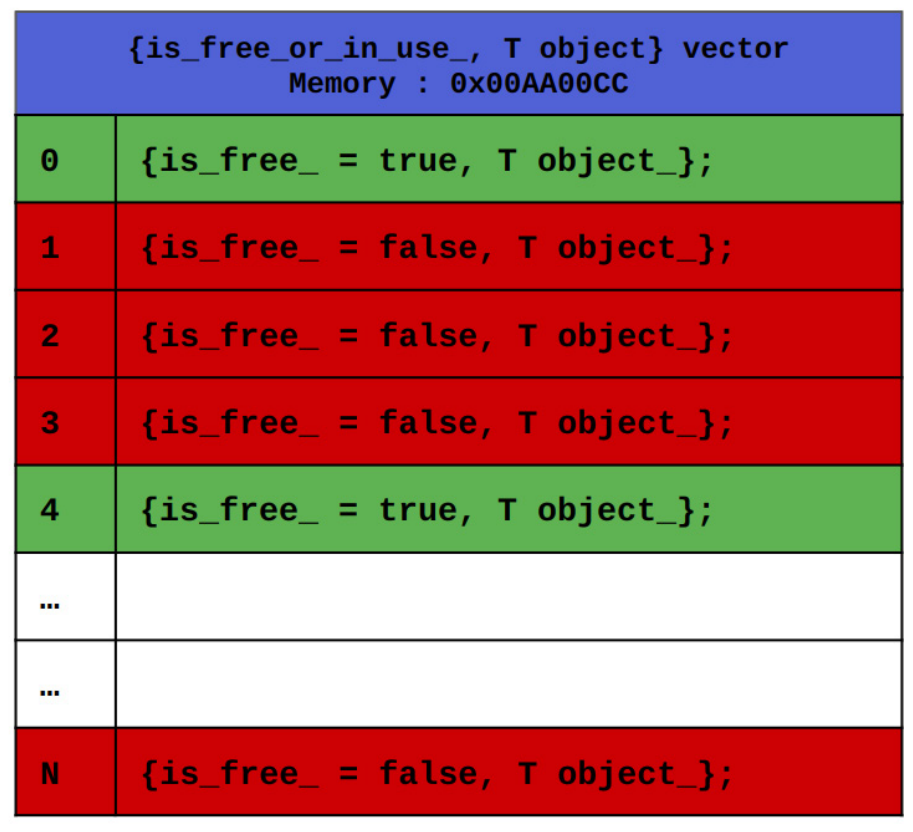
分配与归还
由于已经提前申请好内存块了,因此分配与归还就是标记问题而已。
分配:
- 找空槽位
- 在槽位地址上构造 T
- 标记槽位为 occupied
- 返回 T*
归还:
- 根据 T* 找回所述槽位
- 标记槽位为空
- 以后可以复用这个地址
内存池涉及的变量
- store_:停车场本身
- ObjectBlock:一个停车位
- object_:停在车位里的对象
- is_free_:车位是否空闲
- next_free_index_:下一个可能空闲的车位
- allocate():占用车位并构造对象
- deallocate():释放车位供复用
初始化内存池
public:
    explicit MemPool(std::size_t num_elem)
        : store_(num_elem, ObjectBlock{T(), true}) {
        ASSERT(
            reinterpret_cast<const ObjectBlock*>(
                &store_[0].object_
            ) == &store_[0],
            "T object should be first member of ObjectBlock."
        );
    }

    MemPool() = delete;
    MemPool(const MemPool&) = delete;
    MemPool(const MemPool&&) = delete;
    MemPool& operator=(const MemPool&) = delete;
    MemPool& operator=(const MemPool&&) = delete;
这一段代码要素过多,以下逐个拆解
- 使用 explicit,是为了如下的禁止隐式转换
MemPool<int> pool = 100;
假设没有 explicit,隐式转换按照如下逻辑展开:
- 目标类型已经确定为 MemPool
- 初始值是 int 类型的 100
- 查找能把 100 转换成 MemPool
的非 explicit 构造函数 - 找到 MemPool(std::size_t num_elem)
- 先把 100 从 int 转换成 std::size_t
- 调用构造函数创建 pool 在低延迟系统当中,隐式转换带来以下问题:
- 可能在关键路径出现隐藏的动态分配
- 隐式转换陈胜的 MemPool 可能只是临时对象,会按调用临时创建和销毁(违背使用内存池的初衷)
- 数值转换可能出现错误(比如把 -1 转成一个极大的 size_t 正数)
- store_(num_elem, ObjectBlock{T(), true}) 这里是在初始化 store_ 这个对象,需要结合 MemPool 的私有成员来理解
private:
    struct ObjectBlock {
        T object_;
        bool is_free_ = true;
        };
    std::vector<ObjectBlock> store_;
    size_t next_free_index_ = 0;
store_ 是真正用来存放内存块(又叫槽位)的 vector。这里初始化这个 vector 的时候给出了两个参数
第一个参数 num_elem 表示为 vector 分配多少个元素的空间(内存池的预先分配就是这么实现的);
第二个参数 ObjectBlock{T(), true} 表示把每个元素初始化为什么,这里调用了 ObjectBlock 对象的构造函数
因此 store_(num_elem, ObjectBlock{T(), true}) 表示初始化时为 num_elem 个元素申请了槽位,每个槽位当中能够容纳一个 ObjectBlock,每个 ObjectBlock 都被初始化为 { T 对象, true }
这里的 true 表示该槽位当前空闲,可以容纳一个 T 对象。
- assert
ASSERT(
    reinterpret_cast<const ObjectBlock*>(
        &store_[0].object_
    ) == &store_[0],
    "T object should be first member of ObjectBlock."
);
这里确保第一个 ObjectBlock 的地址等于其中的 T 类型 object_ 的地址
这件事情看起来像多此一举,但是是为了确保内存池的 deallocate() 使用指针访问 ObjectBlock 的时候可以确保正确操作 is_free_ 变量,不会误伤其它变量
- 确保其它构造函数都 =delete 确保它们不会在我们未知的情况下被使用,不会造成隐式转换(与上述函数使用 explicit 的原因一致)
MemPool() = delete;
MemPool(const MemPool&) = delete;
MemPool(const MemPool&) = delete;
MemPool& operator=(const MemPool&) = delete;
MemPool& operator=(const MemPool&) = delete;
allocate() 为对象分配空槽位
template<typename... Args>
T* allocate(Args... args) noexcept {
    auto obj_block = &(store_[next_free_index_]);

    ASSERT(obj_block->is_free_, ...);

    T* ret = &(obj_block->object_);
    ret = new(ret) T(args...);

    obj_block->is_free_ = false;
    updateNextFreeIndex();

    return ret;
}
- 直接分配槽位(因为最后会更新 next_free_index_,使其始终指向空闲槽位)
- 由于 allocate() 最后会调用 updateNextFreeIndex(),这个函数负责搜索到下一个空闲槽位
- 所以每次调用 allocate() 的时候,可以用
obj_block = &(store_[next_free_index_])直接分配槽位。
- 验证不变量:
ASSERT(obj_block->is_free_, ...)
- 这些 ASSERT 在实际生产构建中会被关闭,因此只是在开发过程中用到
- 整个 MemPool 程序中这么多断言就是为了尽早发现错误
- 获取槽位中 T 类型对象的地址 ret
T* ret = &(obj_block->object_)
得到一个指向 T 类型的 object_ 的地址
ObjectBlock
┌──────────────────────┐
│ object_ 的存储空间    │ ← ret
├──────────────────────┤
│ is_free_             │
└──────────────────────┘
- 使用 placement new 构造对象
ret = new(ret) T(args...)
这里 placement new 的返回值就是对象地址 ret。这一点与普通 new 保持一致
placement new 和 普通 new 的区别在于:
- 普通 new 完成 【申请内存】+【构造对象】两件事情
- placement new 只做第二件:【在指定地址上构造对象】
- 在语法上,placement new 需要接收目标地址参数 (ret);普通 new 则没有
- 标记槽位已经占用
obj_block->is_free_ = false;
- 提前寻找下一个空槽位
updateNextFreeIndex();
见下
updateNextFreeIndex() 寻找下个空槽位
private:
    auto updateNextFreeIndex() noexcept {
    const auto initial_free_index = next_free_index_;
    while (!store_[next_free_index_].is_free_) {
        ++next_free_index_;

        if (UNLIKELY(next_free_index_ == store_.size())) {
            next_free_index_ = 0;
        }

        if (UNLIKELY(initial_free_index == next_free_index_)) {
            ASSERT(initial_free_index != next_free_index_, "Memory Pool out of space.");
        }
    }
}
从【上次分配的槽位】开始依次向后扫描,寻找空闲槽位:
- 第一个扫描的槽位有可能是空闲的,因为上次分配的槽位可能已经被释放了
if (UNLIKELY(next_free_index_ == store_.size()))是处理绕到 vector 尾部,需要从 vector 头部继续扫描的情况。这种情况下不是取模,而是直接把next_free_index_置为 0if (UNLIKELY(initial_free_index == next_free_index_))表明如果扫描回到了【本次分配的槽位】,说明内存池已经满了
deallocate() 把槽位标记为空闲
auto deallocate(const T* elem) noexcept {
    const auto elem_index = reinterpret_cast<const ObjectBlock*>(elem) - &store_[0];

    ASSERT(
        elem_index >= 0 &&
        static_cast<size_t>(elem_index) < store_.size(),
        "Element does not belong to this pool."
    );

    ASSERT(!store_[elem_index].is_free_);

    store_[elem_index].object_.~T();
    store_[elem_index].is_free_ = true;
}
-
T* elem 是要释放的对象地址
-
得到要释放的对象所在的 ObjectBlock 在 store_ 当中的索引
const auto elem_index = reinterpret_cast<const ObjectBlock*>(elem) - &store_[0];
- elem 要从 T* 转换成 ObjectBlock* ,因为内存池当中的槽位其实是一个个 ObjectBlock,T 只是 ObjectBlock 的一部分,要释放的是整个 ObjectBlock。
- 这里减去 &store_[0] 是为了得到该 ObjectBlock 在整个 vector 当中的索引 elem_index
-
ASSERT 核对不变量(不管了)
-
调用 object_ (T 类型)的析构函数
store_[elem_index].object_.~T();
在内存池当中归还槽位的时候要调用析构函数!它的职责是结束对象生命周期并释放对象持有的资源,比如关闭文件、释放内存缓冲区、解除句柄或清理成员状态。这个析构函数不会释放 ObjectBlock 本身的内存。
- 把对于 ObjectBlock 的 is_free 标为 true
store_[elem_index].is_free_ = true;
- 然后这里就用这个索引 elem_index,在 vector 当中把对应的 ObjectBlock 的 is_free 标为 true
使用内存池
#include "mem_pool.h"
struct MyStruct {
    int d_[3];
};
int main(int, char **) {
    using namespace Common;
    MemPool<double> prim_pool(50);
    MemPool<MyStruct> struct_pool(50);
    for(auto i = 0; i < 50; ++i) {
        auto p_ret = prim_pool.allocate(i);
        auto s_ret = struct_pool.allocate(MyStruct{i, i+1, i+2});
        std::cout << "prim elem:" << *p_ret << " allocated at:" << p_ret << std::endl;
        std::cout << "struct elem:" << s_ret->d_[0] << "," << s_ret->d_[1] << "," << s_ret->d_[2] << " allocated at:" << s_ret << std::endl;
        if(i % 5 == 0) {
            std::cout << "deallocating prim elem:" << *p_ret << " from:" << p_ret << std::endl;
            std::cout << "deallocating struct elem:" << s_ret ->d_[0] << "," << s_ret->d_[1] << "," << s_ret->d_[2] << " from:" << s_ret << std::endl;
            prim_pool.deallocate(p_ret);
            struct_pool.deallocate(s_ret);
        }
    }
    return 0;
}
运行这段代码会看到的结果是:槽位被分配与回收。回收后的槽位并未归还系统,而是被标记为空闲并可能被再次分配给其它内存。